SHERRICE MOJGANI LIGHTING DESIGN
  • Home
  • About
  • Portfolio
  • Research Project

Theater Comparison Survey

The purpose of this study is to survey the distinct types of theatre architecture across the LORT theatre system to better train the theatre makers of tomorrow. This project made possible through the support of George Mason University's Office of Student Scholarship, Creative Activities and Research 

​More Info about OSCAR @ GMU

A note from an Undergraduate Research Assistant on the eve of her graduation

5/9/2024

 
Picture

Erin Birthchfeild (She/Her) Undergraduate Research Assistant 


Is a graduating Theater Major with a focus in Directing. She was the 23/24 President of the Mason cast of Alpha Psi Omega Theatre Honor Society and Development Manager for the Mason Players. Recent Directing work at Mason includes Thrive or What you Will and Assistant Director for 9 to 5 the Musical and Hunchback of Seville. Erin is graduating from GMU this May and is looking forward to the future. Connect with Erin on Linkedin https://www.linkedin.com/in/erin%2Dbirchfield%2Da340112b2/


As Research Assistant for the LORT Comparison Project this year, I have learned a whole lot about the LORT Theater system and the range of different performance spaces and the various ways they are grouped together, whether it be LORT Grade, stage configuration, or any of the other data we have been collecting.  


In October, I began working on this project collecting publicly available information from LORT D theater websites.  The data I was most often able to find was stage shape, audience capacity, and mission statement.  Occasionally there would be information on square footage, special stage features (trap, turntable, etc.), but from the websites alone, there have been lots of gaps in our data, as is natural for this stage of our research.  

Something that has particularly struck me is how different spaces can be within the groupings at this level.  LORT D spaces vary dramatically, particularly with stage shape and audience capacity, while, as we move on to LORT C, there is a definite drop off in stage variation.  For example, LORT D spaces with thrust configurations, have audience capacities ranging from 75 to over 750.  There are also a large number of thrust and flexible spaces.  In our LORT C category, there are 20 theatres and over half have proscenium configurations.  Though we have not yet started on LORT B and A, I am confident that this trend continues.  As theatres have more status and funding, they also have more established programming and are seemingly more likely to have more traditional large proscenium spaces.

In January and continuing throughout this semester, we have begun contacting theatres directly with the goal of filling in the gaps in our data.  We have begun with simply asking for stage drawings, but will continue asking for further information as the project continues.  

As my time as research assistant concludes, I am excited to see the future of this exciting project!


LORT C and D Stats

4/18/2024

 
In April we started collecting information on LORT C spaces. Between C-1 and C-2 there are only 20 LORT C Stages and of those 12 are Prosceniums. We have combined these numbers with the LORT D number to create overall percentages for C and D stages across the country.  
Stage Type
  • 17 flexible 19% 
  • 6 in the round 7% 
  • 42 proscenium 46% 
  • 25 thrust 28% 
Seating Capacity 
  • 16 under 200  23% 
  • 37 btw 200-400  54% 
  • 16 over 400  23% 

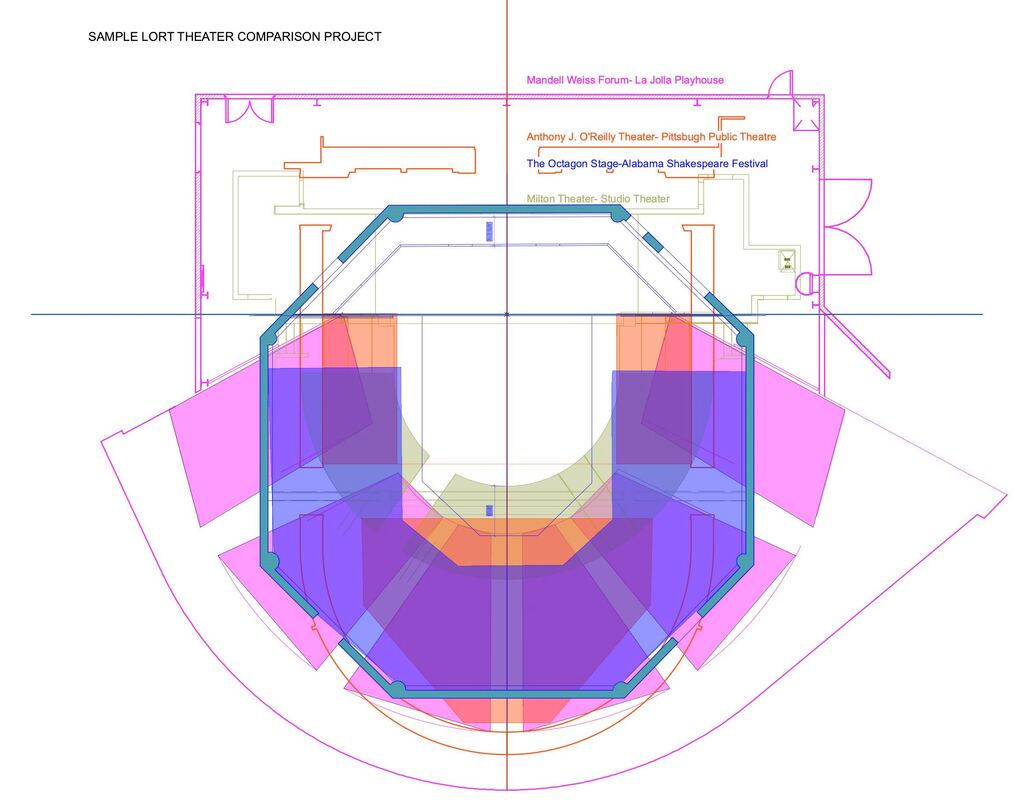
​We have also made progress on the Comparison Ground Plan files, below you will see a sample of four Thrust theatres from four different regions overlayed. Each region has its own color. The Mandell Weiss Forum at La Jolla Playhouse and Anthony J. O'Reilly Theater at Pittsburgh Public Theater are both LORT C Stages. The Octagon Stage at Alabama Shakespeare Festival and Milton Theatre at Studio Theatre are both LORT D Stages.  
We have found, as you can see below, that each thrust stage is incredibly unique.  
Picture

LORT D by the Numbers

1/29/2024

 
We have started the project by focusing on LORT D spaces, as they are the most accessible for emerging theatre makers. We have searched publicly available materials to deduce theatre type and audience capacity.  

We have been able to gather information for 65 of the 68 LORT D Stages. 
 
​
36% of LORT D Stages have a seating capacity between 400-200, and 32% seat less then 200.
 

Within LORT D there are 27 Proscenium stages, 20 Thrust stages, 14 Flexible space stages and 4 “In the Round” stages.  
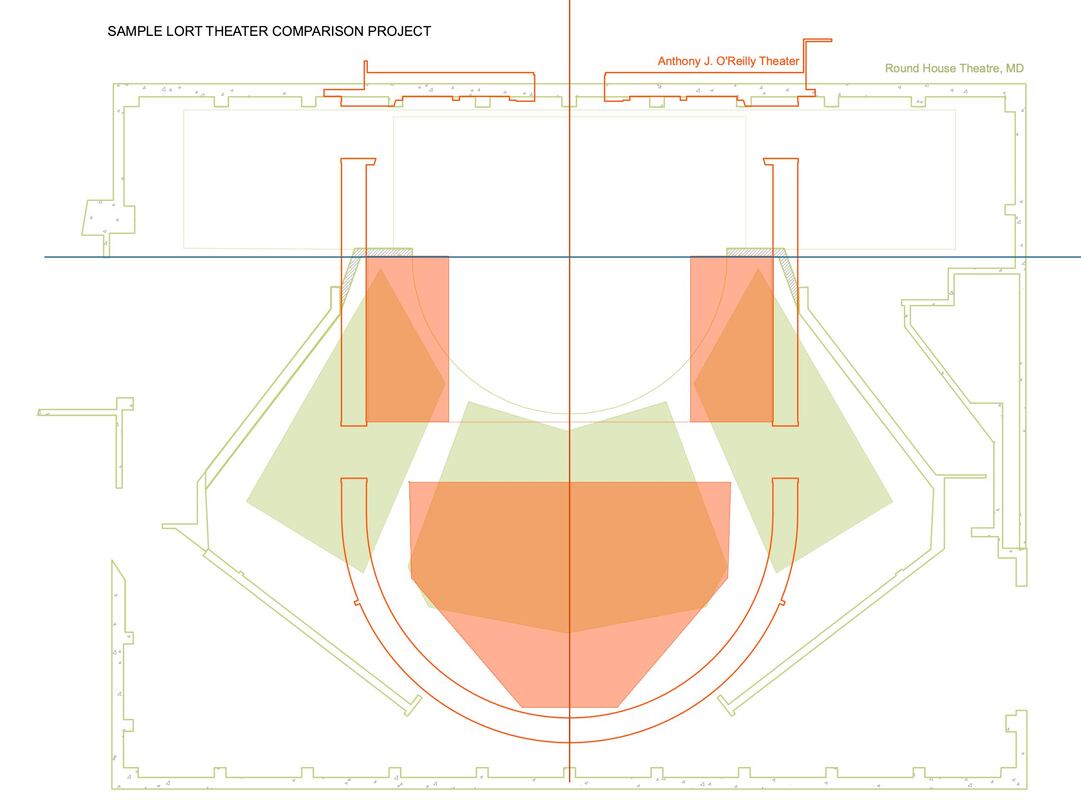
​Our next steps include creating a comparison ground plan document for each stage type, an example of which you can see below, show the overlapping playing space of Round House Theatre in Bethesda MD (LORT D) with Pittsburgh Public Theatre (LORT C) 
Picture

Introduction to the Survey

1/29/2024

 
The Theater Comparison Project is being run out of George Mason University by Associate Professor Sherrice Mojgani, and Undergraduate Researcher Erin Birchfield . We are comparing LORT theatres across the country based on their size, layout, mission, and institution budget. The purpose of this study is to survey the different type of theatre architecture across the LORT theatre system to better train the theatre makers of tomorrow, we also believe the survey will be useful to theatre producers looking for compatible venues for co-productions or touring productions. Our intention is to make the findings of the survey publicly available.  

Educator Highlights: Teaching and Mentoring

5/7/2022

 
I teach a wide range of courses for Mason’s undergraduate population. I teach the lower division courses THR 201: Stage Management, THR 230: Fundamentals of Production and THR 240: Introduction to Theatrical Design. These classes are geared towards students who are just starting their studies at Mason and serve to expose those students to a broader scope of theatre than they may have previously experienced. Most students come to us with an interest in performance, knowing little-to-nothing about other areas, and these classes exist to show them the full breadth of the field, while simultaneously building a shared foundation for all theatre students. There are so many different career paths and concentrations a student can pursue in the study of theatre, and in these classes, my goal is to help students discover what path might be of interest to them. The 300-level courses I teach allow students to focus on their individual disciplines, and my 400-level courses focus on collaboration and communication skills, which are fundamental to our industry. 

Theatre is an inherently collaborative art form. My classes always include a unit or exercise designed to help students practice and hone their skills of collaboration. I have made the process integral and scaffolded in three of the courses I teach — THR 240: Introduction to Theatrical Design introduces basic collaboration skills, THR339: Principles of Design builds to an intermediate level, and THR 496: Text in Production stresses advanced collaboration skills. 

Part of my charge is to be the mentor for all student lighting designers on Mason Players productions. Since arriving in 2017 I have mentored 12 undergraduate students on 14 separate productions. This mentorship involves meeting with the student and tracking their progress, observing and advising them during technical rehearsals, and providing feedback after the production closes. In addition to this, I mentored the student director on a production in spring of 2022.
<<Previous

    Sherrice Mojgani

    Storyteller
    Educator
    ​Activist

    Archives

    May 2024
    April 2024
    January 2024
    May 2022
    October 2020
    September 2020

    Categories

    All

    RSS Feed

Proudly powered by Weebly
  • Home
  • About
  • Portfolio
  • Research Project